The rainbow is based on the Health Canada Food Guide recommendations
about eating a variety of foods from different food groups.The four coloured
bands show the approximate fraction of the recommended amount of foods
in each of the four basic food groups:
- The yellow band represents grain products
- The green band represents vegetables and fruit
- The blue band represents milk products
- The red band represents meats and alternatives
The rainbow should be complete when you have the recommended number of servings for the time period specified (usually one day but you can change that up to seven days as described in lesson 13). The rainbow is an approximation of the number of servings considering the nutrients in the foods you selected compared to those in a typical serving in the Health Canada Food Guide. You will notice that there can be a considerable variation between foods- a fast food apple pie does not make a significant contribution to the vegetables and fruit group, a wiener contributes much less to the meats and alternatives group than a similar amount of beef steak or chicken breast. These approximations are not foolproof (especially in a combination food like pizza it is difficult to determine the number of servings from the various basic food groups) but the rainbow is a quick (but not foolproof) indicator of how well you are following Canada's Food Guide.
If you click on the rainbow in the FoodFocus program you will select a help window with information about the basic food group represented in the portion of the image you clicked.
The happy face is built like a pie divided into four equal parts: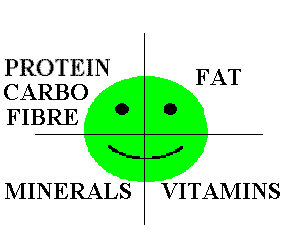
- Fat
- Vitamins
- Minerals
- Protein, Carbohydrates and Fibre
Within each of the four major parts, the size of that portion of the face depends upon a specific nutrient. Each portion of the face is full if each nutrient meets the associated nutrition guideline adjusted to the same energy content. The colour of the happy face indicates the distribution of energy between carbohydrates, fat and protein. A distribution that meets Health Canada recommendations is green. The colour becomes more red as the calories from fat exceed recommendations and more blue as the portion of calories from protein increases.
If you click on the happy face in the FoodFocus program you will select a help window with information about the nutrient represented in the portion of the image you clicked.
The heart pictograph is composed of four parts that reflect four nutrients: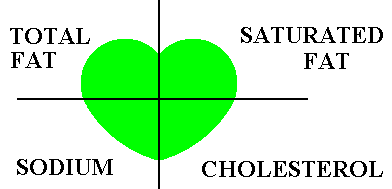
- Saturated Fat
- Cholesterol
- Sodium
- Total Fat
Each portion of the heart is full and the heart is green if each nutrient meets the associated nutrition guideline adjusted to the same energy content. If a nutrient quantity exceeds the maximum suggested by a guideline, the associated portion of the heart shrinks. Saturated fat and total fat have a larger visual effect than sodium and cholesterol. The colour of the heart changes in the same way as the happy face.
If you click on the heart in the FoodFocus program you will select a help window with information about the nutrient represented in the portion of the image you clicked.
The shape of the baby carriage pictograph is composed of four parts
that reflect four nutrients: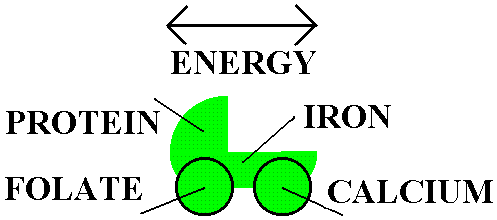
- Protein
- Iron
- Folate
- Calcium
The size of the baby carriage depends upon the total energy in foods in the food list (compared to that in Health Canada Recommended Nutrient Intakes (usually for one day but you can change that up to seven days as described in lesson 13). If the food list contains any alcoholic beverages, the baby carriage becomes oval shaped and the colour changes to red to emphasize Health Canada's message that there is no safe level for alcohol consumption during pregnancy.
If you click on the baby carriage in the FoodFocus program you will select a help window with information about the nutrient represented in the portion of the image you clicked.